Men’s Midlife Health Through Clinical Nutrition
Your body can change in midlife. Not every change is “just getting older.”
You may be gaining weight around your waist, losing muscle, sleeping differently, feeling more tired, or simply noticing that what used to work doesn’t work quite the same way anymore.
It isn’t always just testosterone.
Hormones can be part of the picture. So can sleep, muscle, metabolic health, nutrition, alcohol, stress, medications and other health conditions. Understanding what is actually changing can help you work out what deserves attention next.
THE WIDER PICTURE
Midlife changes rarely happen in isolation.
Hormonal changes can sit alongside changes in muscle, body composition, sleep, metabolic health, sexual function and other aspects of health.
Looking at the broader picture helps identify what nutrition can influence — and what may need medical follow-up.
-
Testosterone levels generally decline with age, but symptoms such as tiredness, reduced strength, changes in mood or sexual function are not specific to low testosterone.
If symptoms suggest testosterone deficiency, this deserves medical assessment rather than guesswork. Diagnosis involves symptoms together with appropriately measured testosterone levels — not age or symptoms alone.
Nutrition can support the broader health picture, but it does not replace investigation or treatment of a diagnosed hormonal condition.
-
Body composition often changes through midlife. Muscle mass can decline while fat mass — particularly around the waist — can increase.
Hormones may be part of that picture, but so can sleep, activity, nutrition, alcohol, energy intake and metabolic health.
Rather than treating weight or waist circumference in isolation, the aim is to understand what is driving the change and what is realistically modifiable.
-
Maintaining muscle becomes increasingly important through midlife and beyond. Muscle supports strength, physical function, glucose metabolism and long-term metabolic health.
Resistance exercise provides the stimulus for muscle, while adequate protein and overall nutrition provide the building blocks needed to maintain and adapt that tissue.
You don’t need to become a bodybuilder. The goal is to protect the muscle you have and support your body to keep doing what you want it to do.
-
Sleep can change through midlife, and poor sleep can affect appetite, energy, recovery, glucose regulation and the ability to maintain healthy routines.
Sleep problems can also have causes that nutrition alone won’t address. In men, persistent snoring, waking unrefreshed or excessive daytime sleepiness may warrant assessment for conditions such as obstructive sleep apnoea.
Improving sleep isn’t simply about getting more hours. Quality, timing and identifying what is disrupting sleep matter too.
-
Metabolic health can change through midlife. Insulin resistance, higher blood glucose, blood pressure and changes in blood fats can develop alongside changes in weight and waist circumference.
Muscle matters here too — it is an important site for glucose use — while movement, sleep, nutrition and body composition can all influence metabolic health.
Blood tests and cardiovascular risk assessment belong with your GP. Nutrition can then help address the modifiable factors around those results.
-
Changes in libido, erections or sexual function can occur through midlife. Testosterone may be relevant, but it is only one part of the picture.
Sexual function can also be influenced by cardiovascular and metabolic health, medications, sleep, alcohol, stress and psychological factors.
New or persistent changes are worth discussing with your GP. They can sometimes provide useful information about health beyond sexual function itself.
-
Medications and underlying health conditions can influence energy, appetite, weight, sleep, sexual function and how you feel day to day.
That is why these changes shouldn’t automatically be attributed to ageing or testosterone. Your medical history, medications and blood results can provide important context.
Nutrition works alongside appropriate medical care — not instead of it. Where something sits outside my scope, I’ll recommend discussing it with your GP or relevant health professional.
Three ways to take the next step
Choose the way you want to begin
Choose the level of support that suits where you are now.
01
Build your understanding
Understand men’s
midlife health
Start with the evidence. Understand what “andropause” can mean, what it doesn’t tell you, and the changes in midlife that may deserve a closer look.
No hormone hype. No miracle fixes.
02
Get practical support
Use the free tools
Generic advice like “eat more protein”, “lose some weight” or “get more sleep” isn’t very useful until you know what deserves attention for you.
Use the free Fast Forward Nutrition tools to explore your protein, energy, fibre, hydration, sleep and other practical starting points.
No email required.
03
Get personalised guidance
Talk with Jon
Ask questions and understand where clinical nutrition may fit for you.
No obligation to book afterwards.
15 minutes · online
Just have a quick question?
Ask the Online Assistant
Prefer to contact Jon directly? Contact Jon
How I work
Midlife changes the context.
The FORWARD Method™ builds the way forward.
What you got away with at 30 might be catching up.
-
Step 01: Understand it
Understand your metabolic picture
Body composition, energy, sleep, muscle, metabolic health, medications, food patterns and blood results can all provide part of the picture. We look at them together to understand what deserves attention first — and what may need medical follow-up.
-
Step 02: Unravel it
Turn understanding into practical structure
Understanding what may be changing is different from knowing what to do about it. We build practical structure around food, protein, movement, sleep and other priorities that fit your circumstances rather than chasing a perfect plan.
-
Step 03: Move forward
Build skills you can keep
The goal isn’t to make you dependent on appointments or another rigid set of rules. It’s to help you understand your own health, make more confident decisions and build changes you can continue in real life.
Meet Jon
Hi, I’m Jon.
I’m a Certified Practising Nutritionist (AARPN), but I came to clinical nutrition by a different route.
Before Fast Forward Nutrition, I spent more than three decades working across the food industry — from running restaurants and opening cafés to food manufacturing, grocery and foodservice. I’ve worked alongside the people developing, selling and positioning food, and seen how commercial decisions shape what appears on the shelf, what gets promoted and ultimately what ends up on our plates.
My approach is also shaped by lived experience of navigating my own weight and metabolic health, alongside formal clinical training.
I’m also a man in midlife. That doesn’t make my experience your prescription, but it does mean I understand that this stage of life can change the context around weight, muscle, energy, sleep and health.
Together, those experiences have given me three perspectives: your biology, the real life around it, and the food environment you’re trying to navigate.
Because nutrition doesn’t happen in a textbook. Your choices are shaped by your physiology, habits and circumstances — and an enormous amount of noise about what you should be doing.
Fast Forward Nutrition isn’t about fast nutrition or quick fixes. It’s about getting through the noise, guesswork and self-doubt to work out what’s happening, what’s getting in the way and what needs attention first — then building a path forward that fits your health and your real life.
Clinical nutrition is also only one part of the picture. Where something needs medical assessment, investigation or treatment, I’ll be clear about that and work alongside your GP or other health professional where appropriate.
Fast forward the noise. Fast forward the self-doubt. Fast forward to you.
That same perspective shapes Real Life Nutrition with Jon, my weekly YouTube series unpacking supermarket specials, pricing, products, nutrition claims and trends — helping you understand how nutrition ends up on your fork and make better decisions for your health and your budget.
Your FORWARD Plan
Practical recommendations to take away and use.
You’ll receive a written, personalised prescription with dietary and lifestyle recommendations, and an agreed supplementation prescription where appropriate.
We focus on what matters now. Recommendations and resources are selected for your needs.
Receive clear priorities
Know what to focus on over the coming weeks.
Know what and how much to eat
Relevant food targets translated into foods, serves and meals.
Choose food in everyday situations
Practical supermarket, café, takeaway and restaurant choices.
Prepare and organise food
Meal preparation and routines that fit your everyday life.
Understand your recommendations
Know why a change matters and how to introduce it.
Monitor your response and adjust
Agree what to notice, then review what works and what needs changing.
How we put it into practice
Your written prescription
Clear priorities and practical instructions to take away and use in everyday life.
Agreed supplementation
Where appropriate, clear instructions on what to take, how much, when and what we’ll review.
Practical take-home guides
Relevant FFN Playbooks explain your recommendations and provide food ideas and examples.
Review together
At your follow-up, we assess your response, troubleshoot difficulties and adjust your prescription.
You don’t need to change everything at once.

Midlife health is shaped across the day.
Not just by your testosterone.
Food. Muscle. Movement. Sleep. Real life.
It isn’t always just testosterone. The work is knowing what’s actually changing for you.
Muscle, sleep, weight, energy, alcohol, stress and metabolic health can all shift through midlife. You don’t need to fix everything at once.
Understand it
See what’s changed in the context of your health, body composition, sleep and real life.
Unravel it
Work out what deserves attention first — and what doesn’t.
Move forward
Build practical changes around your health, training, routines and real life.
Have a question before you book? Contact Jon →

Another way to start
Curious about intermittent fasting?
Fasting FORWARD is a 12-week program with Jon for women and men. We’ll explore whether fasting suits you at your Initial Consultation.
New to Fast Forward Nutrition?
There’s more here to explore.
Men’s midlife health has a lot of moving parts. I’ve built free guides, tools and real-life resources to help you get familiar with them.
Take your time. Stay connected. When you’re ready to bring the pieces together around you, I’ll be here to help.
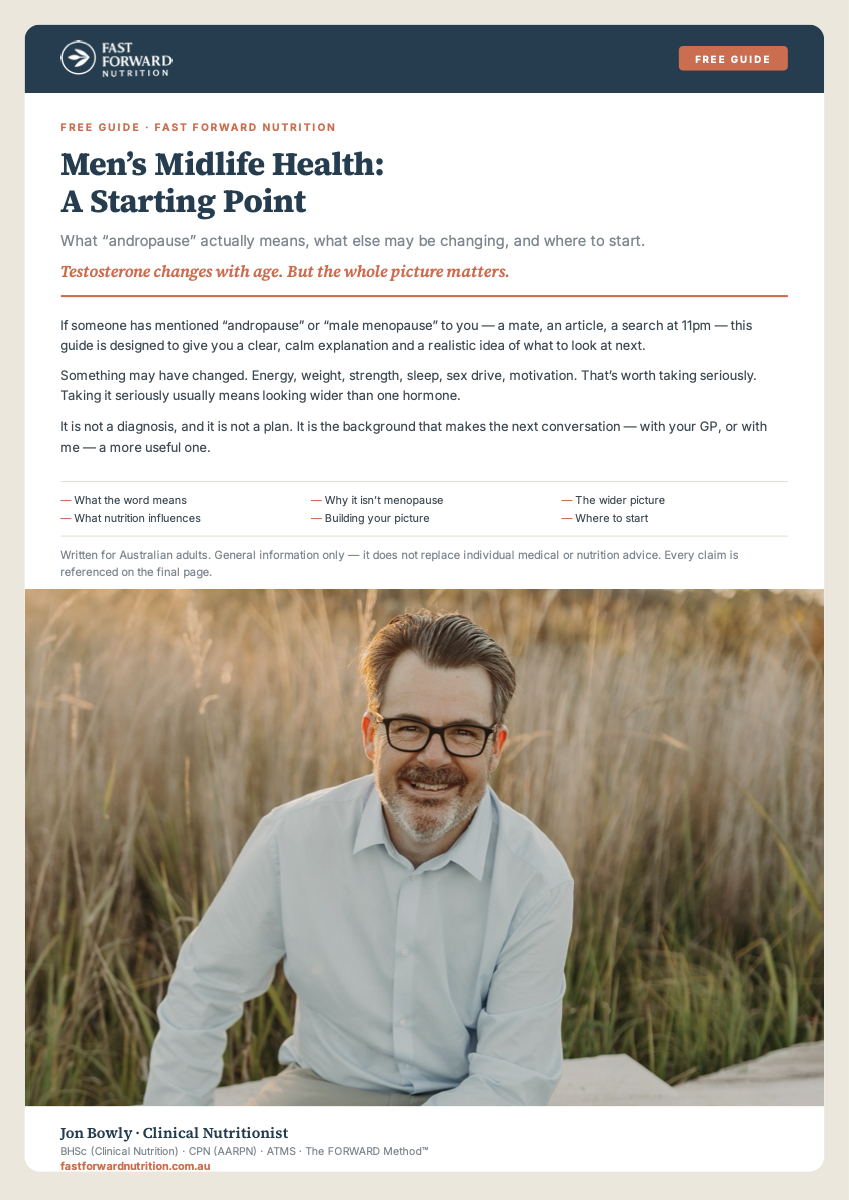
Men’s midlife health
Free 7-page guide
What “andropause” actually means, what else may be changing, and where to start.
Free. Read it in your own time. Designed to work alongside your GP.
Explore more resources
Maybe there’s one thing you want to ask before you go.
Contact Jon →
FROM THE BLOG
Learn your metabolism
Stop guessing